One engineer, two models, two hours: what Karpathy's HackerTube means for hiring
One engineer, two models, two hours: what Karpathy’s HackerTube means for hiring
By Calin Muresan, co-founder of Wise Step Recruiting. Calin spent about 20 years in hands-on software engineering, cloud architecture, and technical leadership before moving into technical recruitment.
One engineer, two models, two hours, zero team. That is how HackerTube is being shared. It is close, but not exact, and the gap is the useful part. On Friday night, October 30, Andrej Karpathy was fed up with YouTube’s recommendations. By Saturday morning he had a live site, HackerTube, that serves 6,454 videos Hacker News commenters kept recommending between 2007 and 2026. In his own write-up, dated October 31, 2026, he puts the build at about two hours. Claude Opus 5.5 wrote and orchestrated the work. Claude Sonnet read the comments. Karpathy did three things by hand.
The question it raises for anyone planning headcount is obvious: if one engineer can ship this alone, what are we hiring a team for? We are former software engineers who now recruit for Data & AI and Cloud & DevOps teams, so we read the build closely. This piece covers what he did, what the controlled evidence on AI speedups says, what the hiring data says about team shape, and what to screen for now.
Key takeaways
- Karpathy built and deployed HackerTube in about two hours (his estimate, October 31, 2026), using Claude Code with Opus 5.5 on Medium effort. Sonnet agents, coordinated by Opus, labelled 39,834 Hacker News comments.
- “Zero team” is not quite right. He did three steps himself (a Google Cloud API key, a virtual private server, a domain), and he describes the experience as still a little like teamwork. The team moved inside the tool.
- It is a best case: greenfield, single owner, personal use, low stakes, run by one of the best-known machine learning engineers in the world. No token count, cost, or source code was published.
- Controlled studies are less dramatic. METR’s 2025 trial found experienced developers took 19% longer with AI while believing they were 20% faster. Its 2026 update leans toward a speedup but calls its own data unreliable.
- Hiring data shows teams compressing, not disappearing: SignalFire puts engineering hiring at large tech firms 11% below 2019, against 25% for tech hiring overall, and new-grad hiring about 65% lower. Hire for orchestration, verification, and ops ownership.
In this article: What he built · The three manual steps · Why it is a best case · The controlled evidence · Team shape · What to hire for · Limits · FAQ · Bottom line
What Karpathy built
HackerTube is a YouTube-style front end, with no accounts, for 6,454 videos that Hacker News users recommended repeatedly from 2007 to 2026, sorted into 150 topics across 16 areas. Karpathy built it in the Claude Code desktop app for Mac, with Opus 5.5 at Medium effort, which he says is his default. His post on X summarises the job as filtering 43 million comments from 20 years of Hacker News down to those 6,454 videos.
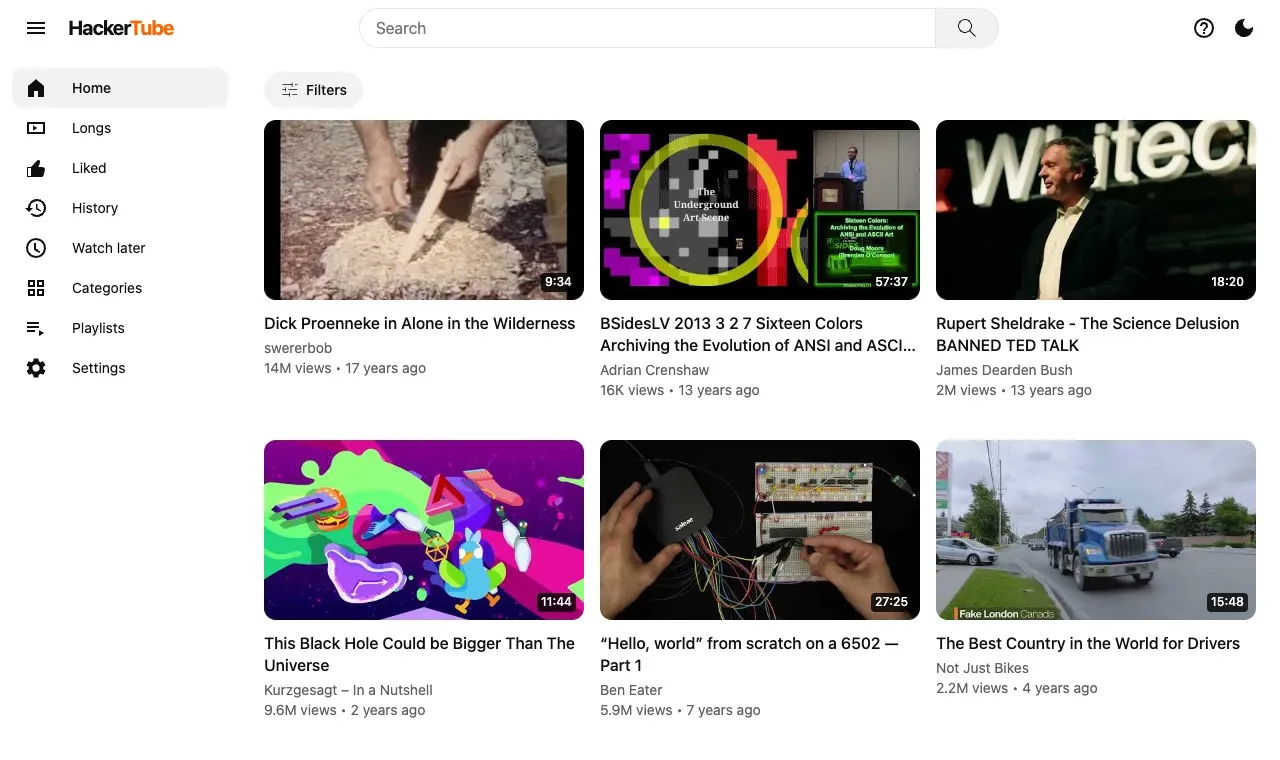 *HackerTube's home page, captured November 3, 2026. Screenshot: [hackertube.org](https://hackertube.org/); video thumbnails belong to their creators.*
The site’s About page gives the pipeline in more detail than the blog post:
- Scan everything. Every comment in a public archive of Hacker News, 2007 to 2026, was searched for YouTube links. That surfaced well over 100,000 distinct videos.
- Keep what lasts. A video stays only if at least three different people linked it with real commentary in at least three different months. That leaves roughly 7,000.
- Read each comment. Claude read each comment with the title of its story and labelled it as a recommendation, a citation, a joke, or a criticism. The export holds 39,834 labelled comments.
- Write cards and rank. Claude wrote a summary card for every video, sorted them into topics, and ranked videos by how many separate months they were recommended in.
- Ship. A YouTube-like interface, “For You” recommendations stored in the browser, keyboard shortcuts, and a 17.8 MB data export under the ODC-By 1.0 licence, with a guide written for AI agents.
The credits split the work. Opus 5.5 built the pipeline, the search, and the site. The labels, cards, and topic list were written by teams of Sonnet 5.5 agents that Opus coordinated.
“Zero team” is not quite right
Karpathy did three steps by hand, and he says the build still felt a little like teamwork. The team did not vanish. It moved inside the tool. In an edit to his post, he lists the manual work: creating a Google Cloud API key for YouTube data, booting a virtual private server (VPS), and buying the domain. After that he gave Claude the server’s IP address and told it to update, deploy, secure, harden, and optimise the code, and, in his words, “it did the whole thing.”
Read the division of labour as an org chart. Opus played the tech lead: it planned the pipeline, wrote the code, and handed bulk reading to Sonnet agents. The Sonnet agents were the team doing the volume work. Karpathy was the product owner and the person holding the credentials. He also writes that he no longer does anything resembling traditional engineering and only talks to Claude.
That is a real shift, and it is the reason this got attention. One line in the viral coverage said he “didn’t touch the code.” That line came from a November 1 tweet by Min Choi, not from Karpathy, so we would not repeat it as his.
For a longer look at what this way of working does to engineering roles, see our piece on AI-native engineering.
Why HackerTube is a best case, not a baseline
HackerTube had almost every condition that makes AI-built software easy, and few of the conditions most product teams live with. That does not make it less impressive. It makes it a ceiling, not an average.
| Condition | HackerTube | A typical product team |
|---|---|---|
| Codebase | New, built from scratch | Years of existing code |
| Owner | One person, who is also the user | Many stakeholders |
| Stakes | Personal tool; a wrong label costs nothing | Paying customers, service-level agreements, on-call |
| Review | None described | Code review, security review, compliance |
| Operator | One of the best-known machine learning engineers in the world | A mixed-seniority team |
| Reproducibility | No token count, cost, or source code published | Must be maintained by others |
Two gaps matter most. First, nobody outside can reproduce the run as described. The post gives no token count, no cost, and no repository. The data export is open, but the code that produced it is not. Second, label quality was not measured. The labels were written by Claude, and no accuracy check is published. For a list of videos to watch, that is fine. For a hiring tool or a billing system, it would not be.
What controlled studies say about AI speedups
Measured average speedups for experienced developers on real codebases are smaller and less certain than demos like this suggest. The best-known test is METR’s randomised trial, published July 10, 2025. Sixteen experienced open-source developers worked on 246 real issues, each randomly assigned to allow or forbid AI tools. With AI, they took 19% longer. Before starting, they expected a 24% speedup. Afterwards, they still believed AI had made them 20% faster.
That study used early-2025 tools, mainly Cursor with Claude 3.5 and 3.7 Sonnet, so it is not the last word. METR ran a larger follow-up from August 2025, with 57 developers and more than 800 tasks, and reported in February 2026 that the point estimates now lean toward a speedup. Both confidence intervals still include zero. METR also says the new data is an unreliable signal, and likely a lower bound, because many developers now refuse to work without AI, so the study cannot recruit them.
Developer sentiment tracks the same unease. In the Stack Overflow 2025 Developer Survey, 84% of respondents use or plan to use AI tools, but 46% distrust the accuracy of AI output, against 33% who trust it. Positive sentiment toward AI tools fell from more than 70% in 2023 and 2024 to 60%.
Put it together and the honest reading is this: the ceiling for one strong engineer has risen fast, and HackerTube is a clear example. The average uplift across a real team on a real codebase is still contested.
Teams are compressing, not disappearing
The hiring data shows fewer entry-level hires and wider spans of control, not the end of engineering teams. SignalFire’s State of Talent Report 2026, published June 22, 2026, compares hiring with 2019 at 12 large tech companies (Alphabet, Meta, Apple, Amazon, Microsoft, and others) and at VC-backed early-stage startups.
Three findings stand out for anyone planning headcount:
- Engineering is holding up better than everything around it. At the large companies, engineering hiring is 11% below 2019 while tech hiring overall is 25% below. At early-stage startups, engineering hiring is up 7%.
- The entry point has narrowed hardest. New-grad hiring is down roughly 65% at the large companies and about 76% at early-stage startups. Stanford’s Digital Economy Lab finds employment of US workers aged 22 to 25 in AI-exposed occupations 19% below the path of less-exposed peers, mostly through reduced hiring. That study covers AI-exposed jobs broadly, not software alone.
- Spans are widening. Each engineering manager at the large companies now oversees about 12 engineers, 14% more than in 2019. At startups the figure is about 15, up 34%.
That is the HackerTube pattern at company scale. More of the volume work goes to agents, and the people who remain are the ones who direct and check them. We covered the entry-level side in detail in Anthropic’s junior share of tech hires, and the wider regional picture in our tech hiring trends for Eastern Europe.
What to hire for when one engineer can ship this
Hire for the five skills HackerTube used, and test them directly. Typing speed and framework trivia were not on the list. This table is our analysis of the build, mapped to what we screen for in Data & AI searches.
| Skill | What it looked like in HackerTube | How to test it |
|---|---|---|
| Problem taste | Spotting that YouTube’s feed was the problem and that Hacker News was a better filter | Ask for a tool they built for themselves and why it needed to exist |
| Data judgement | Deciding a recommendation needs 3+ people across 3+ months, not one viral link | Hand over a messy public dataset; grade the filtering rules, not the code |
| Orchestration | Opus planning and coordinating Sonnet agents on the bulk work | Watch a 60 to 90 minute session with their own agent setup; note how they split and delegate the task |
| Verification | Knowing which outputs to spot-check and which errors are tolerable | Plant three wrong outputs in the work sample; see which ones they catch |
| Ops ownership | API keys, VPS, domain, then “secure, harden, deploy” | Ask what they checked after the agent said the deploy was done |
The applied AI engineer profile is the closest existing role to this. Our read for Romania and the wider Central and Eastern Europe (CEE) region: the hard part is not finding people who use coding agents. It is finding seniors who own the whole path from data to production and can say exactly where they did not trust the model. We see the same split in infrastructure work, which we covered in agentic CI/CD and DevOps hiring.
What HackerTube does not prove
HackerTube proves what one exceptional engineer can do in a morning. It does not measure what a team will gain. Five limits to keep in view:
- One operator, at the top of the field. Karpathy was a founding member of OpenAI and led AI at Tesla. His two hours are not your two hours.
- Self-reported time. The two-hour figure is his estimate, and no third party has repeated the build.
- No cost data. No tokens, no spend, no repository.
- No production pressure. No users with contracts, no legacy code, no compliance review, no on-call rotation.
- A biased filter. Hacker News is a niche community with its own tastes. HackerTube is a selection, not a census.
We could be wrong about the speed of the shift. If agents get much better at verifying their own work, the senior review bottleneck shrinks, and so does the case for hiring around it. The 2026 data we have does not show that yet.
Frequently asked questions
How long did HackerTube take to build?
About two hours, by Karpathy’s own estimate in his October 31, 2026 post. He worked on it on a Saturday morning after being annoyed with YouTube’s recommendations the night before. Nobody else has reproduced the build.
Which AI models built HackerTube?
Claude Opus 5.5, on Medium effort in the Claude Code desktop app, built the pipeline, search, and site. Teams of Claude Sonnet 5.5 agents, coordinated by Opus, labelled the comments and wrote the video cards and topic list.
Can one engineer with AI agents replace a software team?
For a new, low-stakes tool that one person owns, increasingly yes. For production systems with users, legacy code, and compliance, the evidence points to smaller, more senior teams, not none. SignalFire puts engineering hiring at large tech firms only 11% below 2019 levels.
Do AI coding tools make developers faster?
People feel faster, but the measured effect is less clear. METR’s 2025 trial found experienced developers took 19% longer with AI while believing they were 20% faster. Its 2026 update leans toward a speedup but calls the data unreliable.
The bottom line
HackerTube is a clear, well-documented example of one engineer shipping a full product through two models, in about two hours. Read it as a ceiling, not a forecast for your team.
- The team moved inside the tool. Opus led, Sonnet agents did the volume work, and Karpathy owned the problem, the credentials, and the decision to ship.
- Average gains are still contested. Controlled studies have not caught up with the demos.
- Teams are compressing. Fewer entry-level hires, wider spans, engineering hiring holding up.
- Hire the judgement layer. Orchestration, verification, and ops ownership are the scarce skills.
If you are hiring senior Data & AI or Cloud & DevOps engineers in Romania or the wider CEE region, we are former software engineers who assess candidates on exactly those skills. You get a curated shortlist of 3 to 5, with first candidates typically in 10 to 15 days. Talk to a founder about the engineer you need.
Last updated: November 3, 2026. Sources verified November 3, 2026: Andrej Karpathy, “HackerTube” (blog post, October 31, 2026); Karpathy on X (November 1, 2026); HackerTube About page (retrieved November 3, 2026); METR, early-2025 developer study (July 10, 2025); METR, study design update (February 24, 2026); Stack Overflow 2025 Developer Survey, AI section (July 2025); SignalFire, State of Talent Report 2026 (June 22, 2026); Stanford Digital Economy Lab, “Canaries in the Coal Mine?” (Brynjolfsson, Chandar, Chen; revised August 12, 2026). Wise Step process figures are our own operating averages.